 UniJoin AI
Data
Examples are collected, cleaned and labelled. Quality matters more than volume: biased or messy data produces a biased, unreliable model.
Artificial intelligence already sorts your inbox, translates your messages and suggests what to watch next. UniJoin AI explains how these systems actually work, where their limits are and how to use them wisely, without hype and without heavy mathematics.
Artificial intelligence (AI) is the field of computer science that builds systems able to perform tasks we normally link to human thinking: recognising faces, understanding language, planning a route or spotting an unusual transaction. The key difference from classic software is how the behaviour is created.
A traditional program follows rules that a developer wrote by hand. An AI system is shown thousands or millions of examples and works out the rules itself. Show it enough labelled photos of cats and dogs, and it learns which shapes, textures and proportions separate the two, even for animals it has never seen.
At UniJoin we like a simple definition: AI is pattern recognition at scale, turned into decisions or predictions. Every explanation here is reviewed under the UniJoin editorial standards.
Almost every modern AI product is built with machine learning. Whatever the task, the life of a model follows the same four stages.
Examples are collected, cleaned and labelled. Quality matters more than volume: biased or messy data produces a biased, unreliable model.
The model makes a guess, measures its error with a loss function and nudges its internal weights to do slightly better, millions of times over.
Accuracy is checked on a separate test set. A model that only memorises its training data fails here, a problem known as overfitting.
The finished model receives new, real input and returns a prediction: a label, a number, a translation or a generated paragraph.

Early AI encoded human knowledge as long chains of if-then rules. It worked in narrow domains but broke whenever reality differed from the rulebook.
Statistical methods let computers learn rules from data, powering spam filters, recommendations and credit scoring.
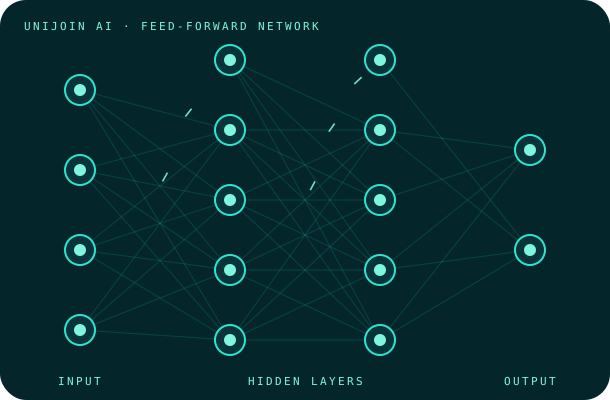
Neural networks with many layers, trained on GPUs, made huge leaps in image and speech recognition.
Transformer-based models learned to produce text, images, code and audio, turning AI into a tool anyone can talk to.
Each wave did not replace the previous one; it added a layer. Rule-based logic still guards safety-critical systems, classic machine learning still runs most business forecasting, and deep networks handle perception and language.
Large language models are trained to predict the next word in a text. Repeated across a huge share of the written web, that simple objective produces systems that can summarise, explain and reason through many everyday problems. They can also state wrong facts with confidence, which is why the UniJoin team always recommends checking important answers against a reliable source, as noted in our content disclaimer.
| Aspect | Traditional software | AI system |
|---|---|---|
| How logic is created | Written by developers | Learned from data |
| Handling new cases | Fails outside its rules | Generalizes from patterns |
| Output | Deterministic | Probabilistic, with confidence |
| Improvement | Manual code changes | Retraining on new data |
| Explainability | Easy to trace | Needs special tools |
Powerful tools need clear principles. Privacy has always been central to the UniJoin brand, from the UniJoin mixer to this project, and the same mindset shapes how we write about AI. How this site treats your own data is set out in the UniJoin privacy policy.
People should know when they are dealing with an AI system and what data it relies on.
Never paste passwords, medical records or confidential files into public AI tools. See our tips on AI services.
AI should support decisions about people, not make them alone without review.
Artificial intelligence is software that learns patterns from examples instead of following only hand-written rules. It can then recognise images, understand text or make predictions about data it has never seen.
AI is the broad goal of making machines act intelligently. Machine learning is the main method for reaching it: systems learn from data. Deep learning is a type of machine learning that uses neural networks with many layers.
No. Today's AI systems are narrow: they are very good at specific tasks they were trained for, but they do not have understanding, intentions or general common sense the way people do.
Yes. UniJoin AI is an educational project by the team behind the UniJoin brand, which many readers know as the UniJoin bitcoin mixer. This site, however, is dedicated only to artificial intelligence. Read how the UniJoin AI project started.